
Live Implementations: peers.social and peermesh.org
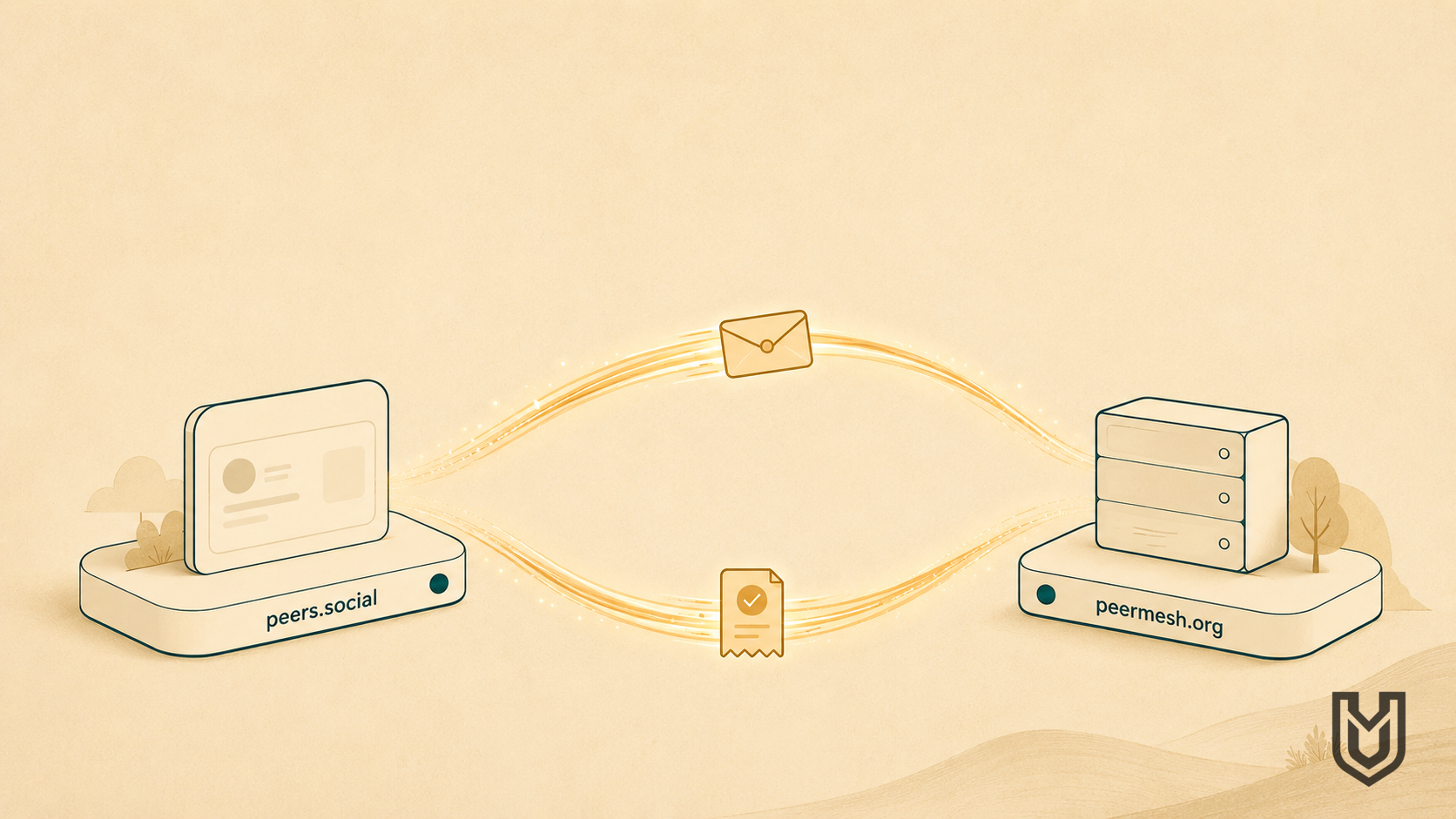
Two live platforms are running the Universal Manifest v0.3 evaluation contract in production: peers.social for self-sovereign identity and peermesh.org for open-source infrastructure.
Universal Manifest v0.3 is not a paper specification. Two platforms are running the evaluation contract in production today.
peers.social
peers.social is a self-sovereign identity platform built local-first. Your data lives on your device, not on a server you do not control. Universal Manifest is the exchange format at the core of the system.
When you interact with another person or service on peers.social, a manifest exchange happens. Both parties present manifests, both run the evaluation sequence, both get structured receipts. Selective disclosure controls what each party sees. Sealed entries remain present-but-unreadable when they are not relevant to the interaction.
peers.social also supports spatial fabric addressing, connecting identity exchange to the spatial computing ecosystem. When you move between contexts (a workspace, a social space, a commercial interaction), the manifest travels with you and the evaluation contract runs at each boundary.
peermesh.org
peermesh.org provides the open-source infrastructure that peers.social runs on. It implements the manifest parsing, the evaluation sequence, the consent model, and the receipt generation. If you want to build a system that speaks Universal Manifest, peermesh.org is a working reference.
The codebase is open. The conformance suite runs against it. Implementers can study how the six evaluation stages (Arrive, Verify, Project, Consent, Compose, Receipt) work in practice, not just in the specification text.
What this proves
A specification is a document. An implementation is evidence. peers.social and peermesh.org demonstrate that the evaluation contract is implementable, that selective disclosure works in a real social context, and that bilateral exchange scales to everyday interactions.
These are not demo environments. They are live platforms with real users making real identity exchanges under the v0.3 contract.
Build on it
If you are evaluating Universal Manifest for your own platform, these implementations provide reference material beyond the spec itself. See what a conformant evaluator looks like in running code.
Read the v0.3 specification. Visit peers.social and peermesh.org.