
Interactive and proof routes are returning behind the calm two-page public front door, not replacing it.
Implementation Sandbox
Explore real manifest behavior in guided browser scenarios.
The sandbox remains the fastest public way to see validation, integration lanes, edge cases, and advanced flows without writing code first. This route now sits inside the shared tool shell instead of acting like an unrelated standalone product.
Scenario Catalog
Choose a path into the contract.
The selector below is the existing browser tool, now framed inside the shared tool-and-proof route family.
Choose a Scenario
Interactive scenarios demonstrating Universal Manifest validation in your browser.
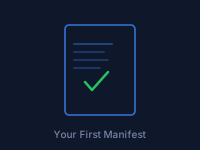
Your First Manifest
Parse and validate a minimal Universal Manifest step by step. Learn what each required field means and why it matters.
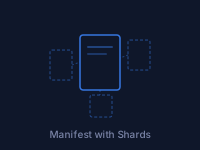
Manifest with Shards
Explore a manifest that contains data shards -- named sections that carry profile, device, or other entity information.
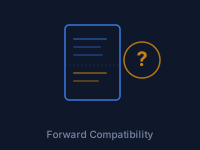
Forward Compatibility
See how a manifest with unknown fields still passes validation. Learn why forward compatibility matters for ecosystem evolution.
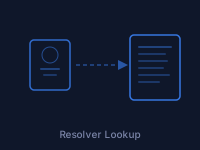
Resolver Lookup
See how a consumer resolves a UMID into a full manifest using a resolver service, then validates and checks freshness.
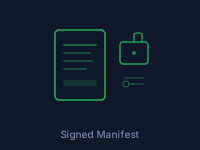
Signed Manifest (Ed25519 Verification)
Verify a v0.2 signed manifest end-to-end using real Ed25519 cryptography in the browser. Change any field to see verification fail.
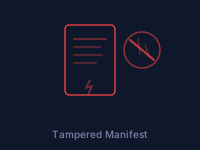
Tampered Manifest Detection
See how Ed25519 verification catches a manifest that was modified after signing. The signature no longer matches the data.
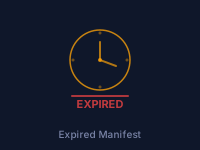
Expired Manifest Rejection
See how consumers reject a manifest whose TTL has expired. Structural validation passes, but the freshness check catches the stale data.
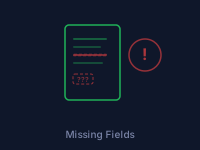
Missing Required Fields
Watch validation catch a manifest missing @context. Structural checks reject it before any deeper processing.
Invalid Signature Algorithm
See how v0.2 validation rejects a manifest with a non-Ed25519 signature algorithm. Only Ed25519 is permitted.
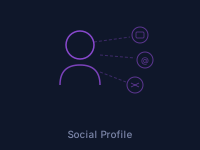
Social Profile Projection
A social rendering service receives a manifest, checks consent, extracts the publicProfile facet, and renders a schema:Person profile card.
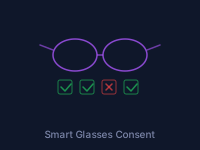
Smart Glasses Consent Check
A smart glasses runtime receives a manifest, evaluates per-capability consent entries, and builds a permission matrix controlling what the glasses are allowed to do.
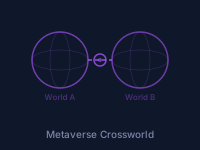
Spatial Computing Portaling and Cross-World Identity
A subject portals between different spatial computing environments using the same manifest. Consent controls which features each destination can access.
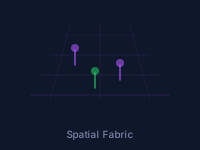
RP1 Spatial Fabric Anchoring
An RP1 spatial fabric node receives a manifest with spatial anchors, attachment freshness hints, and place membership data. Consent controls whether cross-world linking is permitted.
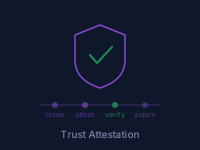
OMATrust Attestation Lifecycle
An OMATrust-aware consumer portal processes attestation lifecycle events (active, revoked, superseded) and evaluates trust mode claims from the manifest.
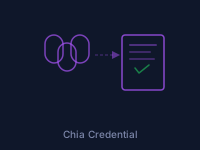
DID + VC Credential Binding
A credential verification service processes a manifest with DID + VC binding. Consent controls whether credential data can be shared and validated.
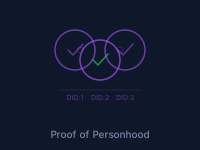
Proof-of-Personhood Multi-Provider
A social platform evaluates Sybil resistance by reading multiple proof-of-personhood claims from independent providers. Trust grows with the number of verified providers.
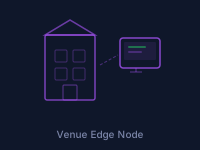
Venue Edge Node Manifest
An edge node and enrolled display device process a venue manifest with identity, content policy, and device enrollment data. Content rendering follows the venue's policy facets.
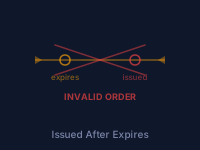
Issued After Expires
A manifest where issuedAt is later than expiresAt. This temporal inconsistency is caught by validation, preventing consumers from accepting logically impossible validity windows.
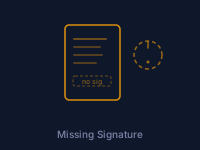
Missing Signature (v0.2)
A v0.2 manifest with no signature block. Version 0.2 requires cryptographic signing -- stripping the signature must cause immediate rejection.
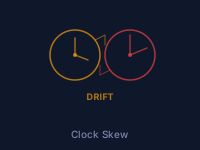
Clock Skew Detection
A manifest with issuedAt set to the year 2099. Consumers SHOULD flag future issuedAt values as potential clock skew or intentional manipulation.
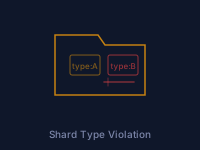
Shard Type Violation
A manifest with a shard that uses @type "um:NotAShard" instead of "um:Shard". Every shard must declare um:Shard in its type to be recognized by consumers.
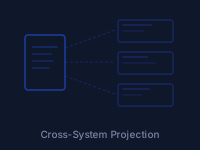
Cross-System Projection
One manifest, three consumers. A social platform, smart glasses headset, and metaverse engine each project different views from the same Universal Manifest.
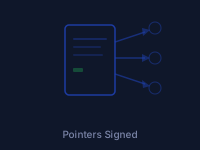
Manifest with Pointers (Signed)
A lightweight v0.2 manifest that uses pointers to reference external resources instead of embedding data in facets. Signed with Ed25519 for authenticity.
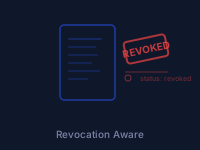
Revocation-Aware Verification
Extended v0.2 verification that includes a simulated revocation status check. After cryptographic verification, the consumer checks whether the manifest has been revoked.
Full v0.2 Integration
Four-layer validation: structure, facets, signature block, and real Ed25519 cryptographic verification. Demonstrates the complete v0.2 verification pipeline.
Try adjusting your search or filter criteria.