Choose a Scenario
Interactive scenarios demonstrating Universal Manifest validation in your browser.
Layout and Engine Test
A minimal scenario to verify that the three-panel layout, step engine, and all controls work correctly.
Your First Manifest
Parse and validate a minimal Universal Manifest step by step. Learn what each required field means and why it matters.
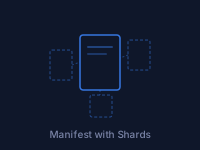
Manifest with Shards
Explore a manifest that contains data shards -- named sections that carry profile, device, or other entity information.
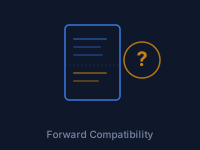
Forward Compatibility
See how a manifest with unknown fields still passes validation. Learn why forward compatibility matters for ecosystem evolution.
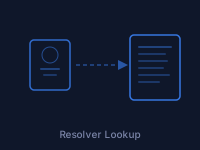
Resolver Lookup
See how a consumer resolves a UMID into a full manifest using a resolver service, then validates and checks freshness.
Signed Manifest Verification
Walk through cryptographic signing and verification of a manifest using the v0.2 signature profile.
Tampered Manifest Detection
Edit a signed manifest to see how consumers detect and reject tampered data using cryptographic verification.
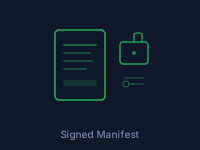
Signed Manifest (Ed25519 Verification)
Verify a v0.2 signed manifest end-to-end using real Ed25519 cryptography in the browser. Change any field to see verification fail.
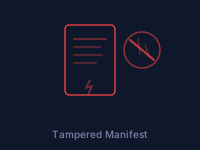
Tampered Manifest Detection
See how Ed25519 verification catches a manifest that was modified after signing. The signature no longer matches the data.
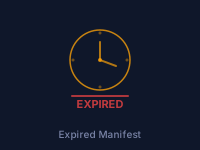
Expired Manifest Rejection
See how consumers reject a manifest whose TTL has expired. Structural validation passes, but the freshness check catches the stale data.
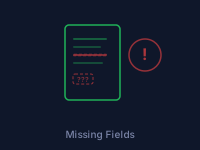
Missing Required Fields
Watch validation catch a manifest missing @context. Structural checks reject it before any deeper processing.
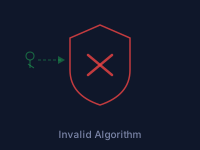
Invalid Signature Algorithm
See how v0.2 validation rejects a manifest with a non-Ed25519 signature algorithm. Only Ed25519 is permitted.
Spatial Fabric Integration
Demonstrate how the RP1 Spatial Fabric consumes a Universal Manifest to display verified entity information in 3D space.

Social Profile Projection
A social rendering service receives a manifest, checks consent, extracts the publicProfile shard, and renders a schema:Person profile card.
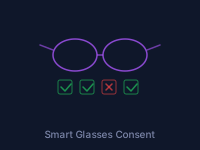
Smart Glasses Consent Check
A smart glasses AR runtime receives a manifest, evaluates per-capability consent entries, and builds a permission matrix controlling what the glasses are allowed to do.
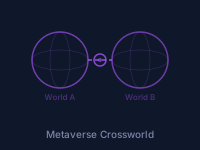
Metaverse Cross-World Identity
Two virtual worlds receive the same manifest and project cross-world identity. Consent controls which features each world can access.
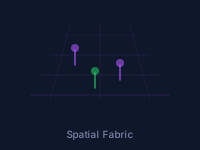
RP1 Spatial Fabric Anchoring
An RP1 spatial fabric node receives a manifest with spatial anchors and place membership data. Consent controls whether cross-world linking is permitted.
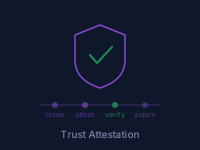
OMATrust Attestation Lifecycle
An OMATrust-aware consumer portal processes attestation lifecycle events (active, revoked, superseded) and evaluates trust mode claims from the manifest.
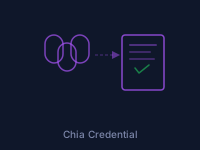
Chia DID/VC Credential Binding
A credential verification service processes a manifest with Chia blockchain DID binding. Consent controls whether credential data is shared and whether on-chain publishing is allowed.
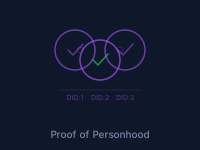
Proof-of-Personhood Multi-Provider
A social platform evaluates Sybil resistance by reading multiple proof-of-personhood claims from independent providers. Trust grows with the number of verified providers.
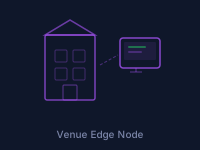
Venue Edge Node Manifest
An edge node and enrolled display device process a venue manifest with identity, content policy, and device enrollment data. Content rendering follows the venue's policy shards.
Expired Manifest Handling
See what happens when a consumer encounters a manifest whose expiresAt date has passed.
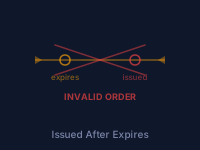
Issued After Expires
A manifest where issuedAt is later than expiresAt. This temporal inconsistency is caught by validation, preventing consumers from accepting logically impossible validity windows.
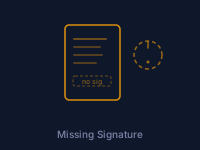
Missing Signature (v0.2)
A v0.2 manifest with no signature block. Version 0.2 requires cryptographic signing -- stripping the signature must cause immediate rejection.
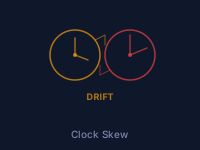
Clock Skew Detection
A manifest with issuedAt set to the year 2099. Consumers SHOULD flag future issuedAt values as potential clock skew or intentional manipulation.
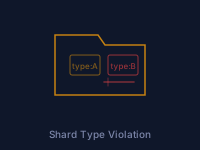
Shard Type Violation
A manifest with a shard that uses @type "um:NotAShard" instead of "um:Shard". Every shard must declare um:Shard in its type to be recognized by consumers.
Multi-Claim Advanced Manifest
Explore a complex manifest with multiple claims, nested structures, and advanced validation rules.
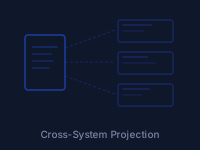
Cross-System Projection
One manifest, three consumers. A social platform, AR headset, and metaverse engine each project different views from the same Universal Manifest.
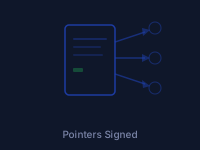
Manifest with Pointers (Signed)
A lightweight v0.2 manifest that uses pointers to reference external resources instead of embedding data in shards. Signed with Ed25519 for authenticity.
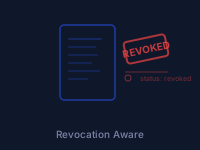
Revocation-Aware Verification
Extended v0.2 verification that includes a simulated revocation status check. After cryptographic verification, the consumer checks whether the manifest has been revoked.
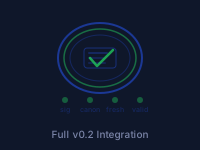
Full v0.2 Integration
Four-layer validation: structure, shards, signature block, and real Ed25519 cryptographic verification. Demonstrates the complete v0.2 verification pipeline.
Try adjusting your search or filter criteria.